
Skip to content
ComplianceCatalyst

Strengthening programs. Influencing outcomes. Leading teams.

Sharper thinking on ethics, conflicts, and compliance strategy for financial-services leaders.

Briefs on the moments where rules meet judgment — written for the people accountable for getting it right.

Start here

All pieces →

Leadership

Prediction Markets and the Expanding Control Surface

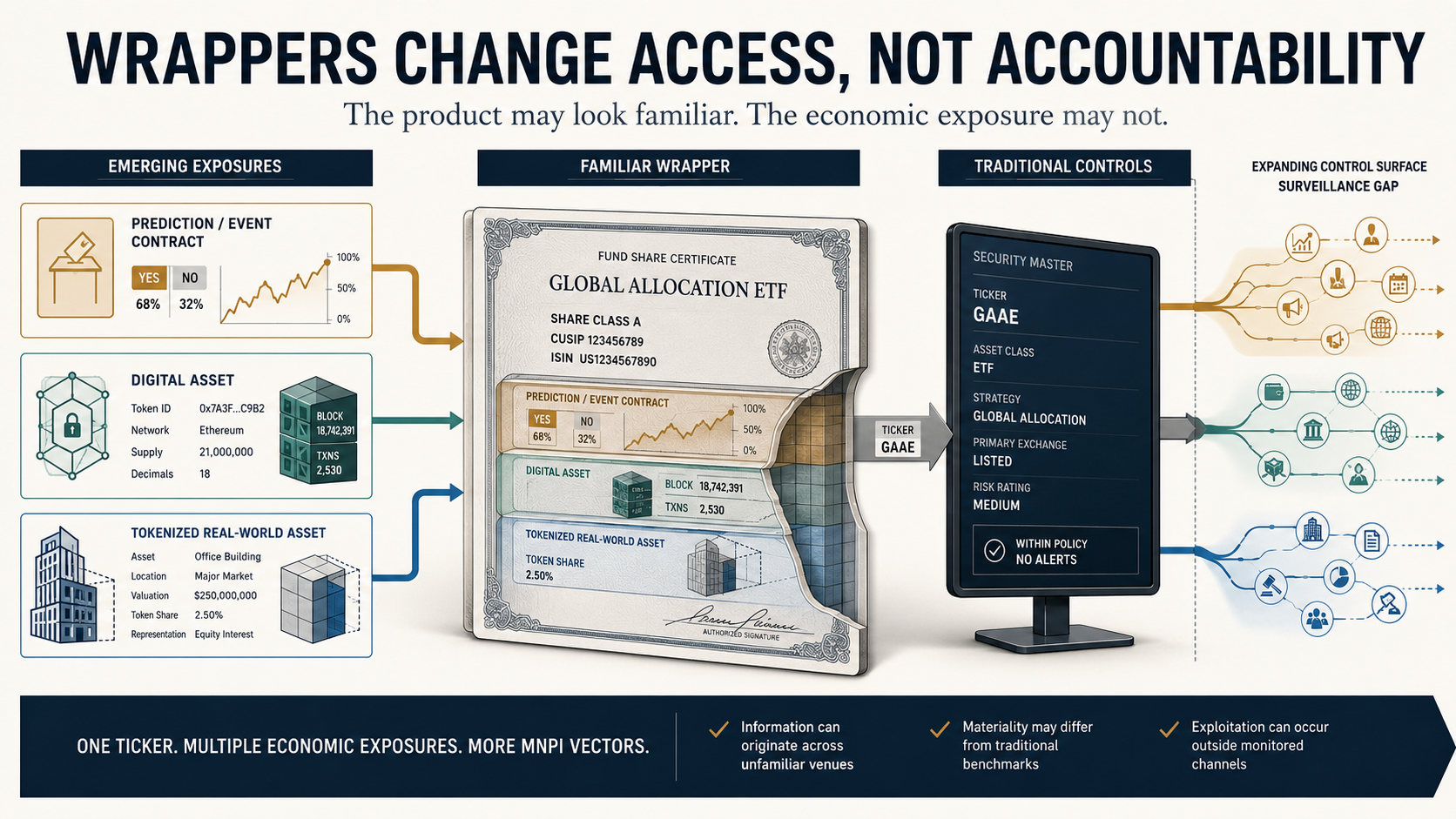
Prediction markets are often discussed as a new asset class or an extension of sports betting, but their broader significance may lie elsewhere. As they create new ways to monetize information outside traditional securities markets, they challenge long-held assumptions about market structure, surveillance, and compliance. Rather than viewing them as a niche product, firms should recognize prediction markets as part of a broader shift that is expanding where - and how - valuable information can be traded,

Technology

The Hidden Cost of Frictionless Oversight

Compliance budgets and AI adoption are rising fast — yet the 2026 StarCompliance benchmark shows workloads barely falling. The reason may be that compliance is a judgment function, and some friction is what produces good decisions.

Regulatory

Cybersecurity Assumes Breach. Why Doesn’t Compliance?

Inside most organizations there are two systems operating at once: the documented one and the behavioral one. Cybersecurity learned to assume breach — why does compliance still assume alignment?

Leadership

Some Firms Build Consensus. Others Build Conviction.

Modern compliance programs are filled with escalation paths designed to reduce risk. But firms develop very different decision-making cultures — some build conviction, others diffuse accountability through endless approvals.

Technology

When Digital Assets Integrate, Personal Exposure Follows

BlackRock is expanding tokenized offerings and JPMorgan is embedding blockchain settlement rails. As digital assets integrate across product platforms and market structure, employee-level personal exposure rarely lags behind.

Regulatory

When New Risks Don't Land the Same Way

In most compliance discussions, emerging risks are treated as if they arrive uniformly across the institution. They don’t — they arrive through people, and people respond differently.

Leadership

Athletes Train for Pressure. Why Doesn’t Compliance?

Elite athletes don’t rely on instinct in critical moments — they train for pressure. Financial institutions call their top performers athletes, yet compliance still trains for policies, not for how decisions form under pressure.

Technology

Reimagining Insider Trading for a World Beyond Securities

Prediction markets, digital assets, and decentralized platforms all push the limits of “insider trading.” For compliance leaders it’s a call to rethink how we define and manage material, nonpublic information.

Regulatory

Where Risk Actually Surfaces

Most compliance frameworks assume controls catch issues first. In practice, risk surfaces when a person notices something doesn't add up — and what matters is whether escalation has somewhere reliable to go.

The mission

Compliance is too often treated as a brake. ComplianceCatalyst argues the opposite: done well, it is a source of conviction and speed — the discipline that lets financial-services firms move decisively without losing the trust they run on.

About Michael Ross

Michael Ross writes on ethics, conflicts of interest, and compliance strategy for financial-services leaders, drawing on years inside the function.

Disclaimer: The views expressed here are my own and do not represent those of any employer, client, or affiliated organization.

Connect on LinkedIn

Top News

All news →

Comments (0)